











Indholdsfortegnelse
- Ghost Train Haze Effects: What to Expect ›
- Ghost Train Haze Terpenes: Profile and Pharmacological Relevance ›
- Ghost Train Haze THC Content and Cannabinoid Breakdown ›
- Ghost Train Haze Sativa Genetics and Origin ›
- Ghost Train Haze vs Other Haze Strains: Super Silver Haze and Amnesia Haze ›
- Ghost Train Haze Growing: Cultivation Notes for Experienced Growers ›
- Ghost Train Haze Review: Who This Strain Suits ›
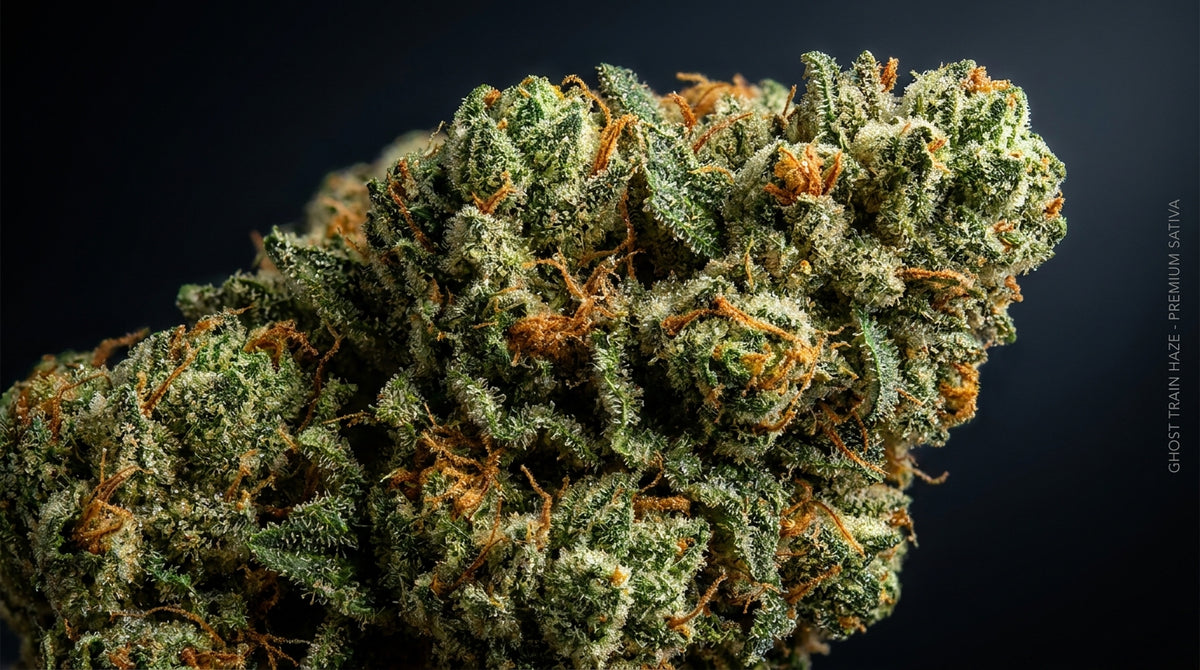
Ghost Train Haze is a sativa-dominant hybrid that consistently tests between 20 and 27 percent THC, placing it among the most potent haze-family cultivars in the legal European market. Bred by Rare Dankness Seeds, it crosses Ghost OG with Neville's Wreck to produce a strain with an intense cerebral onset, a terpene profile dominated by terpinolene, and a growth structure that rewards experienced cultivators. Browse Canapuff cannabis flowers for the full current range of available cultivars.
Ghost Train Haze Effects: What to Expect
The effects of Ghost Train Haze are predominantly cerebral and fast-acting. Within minutes of consumption, most users report a sharp increase in mental alertness, creative association, and sensory heightening. The onset is typically described as pressure behind the eyes followed by a distinct shift in focus and mood.
Terpinolene, the dominant terpene, correlates with energizing, anxiety-adjacent experiences in sensitive individuals at high THC doses (Ito et al., 2012, PubMed 22038065). Unlike indica-dominant strains, Ghost Train Haze produces little physical sedation at moderate doses. At higher doses the experience can tip into anxiety or racing thoughts, a risk well-documented in high-THC sativa cultivars (Murray et al., 2019). Understanding the difference between indica and sativa effects helps set realistic expectations before trying a strain of this potency.
Reported effects among experienced users include:
- Euphoria and elevated mood
- Increased focus and creative ideation
- Heightened sensory perception
- Mild appetite stimulation at moderate doses
- Potential anxiety or paranoia at high doses
Duration is typically two to three hours for the acute phase, with a gradual wind-down that lacks the sedative tail common in indica-heavy cultivars. Users with existing cannabinoid tolerance generally report a more manageable experience than first-time users at comparable doses.
Ghost Train Haze Terpenes: Profile and Pharmacological Relevance
The terpene profile of Ghost Train Haze is one of its most distinguishing features. Laboratory analyses of certified cultivars consistently show the following dominant terpenes:
| Terpene | Typical concentration | Primary associations |
|---|---|---|
| Terpinolene | 0.8 to 1.4% | Uplifting, antioxidant, antimicrobial (preclinical) |
| Ocimene | 0.4 to 0.8% | Sweet-floral top note, anti-inflammatory (preclinical) |
| Myrcene | 0.2 to 0.5% | Sedative potential at high concentration, muscle relaxation |
| Beta-Caryophyllene | 0.1 to 0.3% | CB2 receptor partial agonist, anti-inflammatory |
| Limonene | 0.1 to 0.25% | Mood elevation, stress response modulation |
Terpinolene is the defining terpene of Ghost Train Haze and the broader Neville's Wreck lineage. It gives the strain its characteristic pine-citrus-herb aroma, often described as fresh, sharp, and slightly floral. In a review of cannabis chemotypes, Russo (2011) argued that terpene-cannabinoid interactions produce meaningful clinical differentiation between strains with similar THC percentages (PubMed 21749363). The terpinolene-dominant chemotype of Ghost Train Haze is therefore not just an aromatic property but a contributor to its specific effect signature.
Ocimene adds the sweet, almost tropical top note that distinguishes Ghost Train Haze from more piney haze cultivars. Beta-caryophyllene is notable as the only terpene known to bind directly to CB2 receptors, which regulate inflammatory signaling (Gertsch et al., 2008).
Ghost Train Haze THC Content and Cannabinoid Breakdown
Ghost Train Haze regularly tests between 20 and 27 percent THC. CBD content is typically below 0.1 percent, making it a near-pure THC chemotype with minimal cannabidiol buffering. For context on what these THC levels mean relative to other cultivars, see the overview of the highest THC percentages ever recorded in cannabis.
In the German pharmaceutical context, two certified variants are widely prescribed:
- Pedanios 22/1: 22% THC, approximately 1% CBD. Produced to EU-GMP standards. The most commonly referenced variant in German prescription data.
- Enua 27/1: 27% THC, approximately 1% CBD. One of the highest-THC certified medical cannabis products in the DACH region.
The EMCDDA notes a consistent correlation between high-potency cannabis and increased incidence of acute adverse events (EMCDDA Technical Report). For medical patients, titration starting at low doses is standard clinical practice. Regular consumers should also be aware of how tolerance builds with high-THC cultivars and how to manage it.
Ghost Train Haze Sativa Genetics and Origin
Ghost Train Haze was bred by Rare Dankness Seeds, crossing Ghost OG (an OG Kush phenotype) with Neville's Wreck, itself a cross of Arcata Trainwreck and Neville's Haze. The name references both parent strains: Ghost from Ghost OG, Train from Trainwreck. It won the High Times Cannabis Cup in the sativa category in 2012, bringing it to wider international attention.
- Ghost OG: Contributes resin density, compact bud structure, myrcene and beta-caryophyllene terpenes
- Neville's Wreck: Contributes terpinolene dominance, sativa growth pattern, cerebral effect profile, and long flowering time
Ghost Train Haze has no direct connection to the historical Haze breeding lines from Santa Cruz, California, though it shares the sativa-dominant phenotype and terpinolene character associated with classic haze genetics. For another well-documented member of the haze family, the G13 Haze strain guide covers a closely related cultivar with a distinct effect profile.
Ghost Train Haze vs Other Haze Strains: Super Silver Haze and Amnesia Haze
Haze-family strains share sativa-dominant genetics, long flowering periods, and a tendency toward cerebral, energizing effects. Ghost Train Haze, Super Silver Haze, and Amnesia Haze are three of the most commonly compared cultivars in this category.
| Property | Ghost Train Haze | Super Silver Haze | Amnesia Haze |
|---|---|---|---|
| Genetics | Ghost OG x Neville's Wreck | Skunk x Northern Lights x Haze | Haze x Afghan x Hawaiian x South Asian |
| THC range | 20 to 27% | 18 to 23% | 20 to 25% |
| CBD | Below 0.1% | Below 0.1% | Below 0.1% |
| Dominant terpene | Terpinolene | Myrcene / Ocimene | Terpinolene / Myrcene |
| Aroma | Pine, citrus, fresh herb | Sweet citrus, skunky | Earthy lemon, floral |
| Effect onset | Fast, sharp | Moderate, smooth | Gradual, building |
| Effect character | Intense cerebral, anxiety risk at high dose | Energizing, euphoric, forgiving | Euphoric, creative, long duration |
| Flowering time | 65 to 80 days | 70 to 80 days | 65 to 75 days |
| Indoor yield | 300 to 450 g/m² | Medium to high | High |
| Growing difficulty | High | Moderate | Moderate |
Ghost Train Haze vs Super Silver Haze: Super Silver Haze, bred by Mr. Nice Seed Bank from Skunk, Northern Lights, and Haze genetics, is the more approachable option. Its myrcene-forward terpene profile produces a smoother, more rounded onset with less anxiety risk. THC peaks around 23 percent rather than 27, giving more predictable dose management. Super Silver Haze is often recommended as a daytime productivity strain, while Ghost Train Haze is better suited to users who have already established tolerance to high-potency sativa cultivars.
Ghost Train Haze vs Amnesia Haze: Amnesia Haze shares the terpinolene-adjacent chemotype, which is why the two are frequently compared for their cerebral, creative-leaning effects. Amnesia Haze's Afghan lineage introduces some indica structural traits that extend duration and smooth out acute anxiety risk. It produces higher indoor yields and is easier to grow, making it more common among DACH commercial cultivators. Ghost Train Haze surpasses Amnesia Haze in raw THC ceiling and sharpness of onset.
Ghost Train Haze Growing: Cultivation Notes for Experienced Growers
Ghost Train Haze is widely considered a strain for experienced cultivators. Its sativa-dominant structure means it grows tall during the vegetative phase, often stretching significantly during the first two to three weeks of flower. Without training, plants can double in height during the stretch.
- Flowering time: 65 to 80 days from 12/12 light flip
- Indoor height: 100 to 180 cm without topping or training
- Recommended training: LST, topping, or SCROG to manage stretch
- Temperature: 20 to 28°C during vegetative phase; slightly cooler in late flower to preserve terpenes
- Humidity: 40 to 50% during flower to reduce mold risk
- Nutrient demands: Moderate to high nitrogen during veg; increase phosphorus and potassium from week three of flowering
- Indoor yield: 300 to 450 g/m² under optimized conditions
- Outdoor suitability: Warm continental climates; harvest late October in central European conditions
The dense bud structure that develops in the final flowering weeks creates some vulnerability to botrytis (grey mold) in humid environments. Adequate air circulation and keeping relative humidity below 50 percent during late flower are the primary preventive measures. For a full overview of how to manage this risk, the guide to identifying mold on cannabis covers signs, causes, and prevention in detail. The complete guide to the cannabis flowering phase is also useful context for timing the harvest window correctly.
The harvest window is relatively narrow. Monitor trichome development under magnification, targeting the transition from clear to milky-amber. Early harvest results in a more anxious, racy effect profile; late harvest shifts effects toward sedation as THC partially degrades to CBN.
Ghost Train Haze Review: Who This Strain Suits
Ghost Train Haze is not a neutral or universally recommended strain. Its combination of very high THC, terpinolene dominance, and fast-acting cerebral effects makes it a specific tool for a specific type of user.
It suits:
- Experienced cannabis consumers with established tolerance to high-THC sativa cultivars
- Users seeking daytime use without sedation, particularly for creative or cognitively demanding work
- Medical patients prescribed the Pedanios 22/1 or Enua 27/1 variants for conditions where high-THC sativa chemotypes are clinically indicated
- Cultivators looking for a premium, high-resin sativa with strong competitive genetics
It does not suit:
- Cannabis-naive users or those with low THC tolerance
- Individuals with a personal or family history of psychosis, anxiety disorders, or schizophrenia spectrum conditions
- Users seeking sedating or body-heavy effects
- Growers with limited vertical space or no experience managing sativa phenotypes
For ready-to-use options, premium pre-rolled joints are available in several cultivars. For the strongest available cannabinoid products, browse the strong cannabinoids collection. If Ghost Train Haze's potency feels too high as a starting point, the THCP vs THC comparison covers how different cannabinoid potencies scale relative to each other.
This article is for informational purposes only and does not constitute medical advice. Consult a qualified physician before using cannabis for medical purposes.